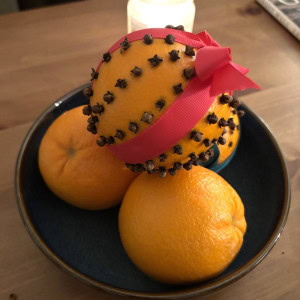
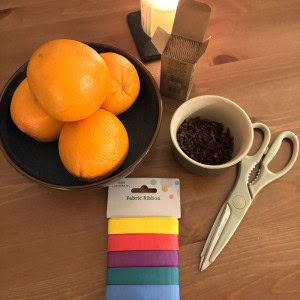
Get into the festive spirit by making a clove-orange pomander!

A pomander is an orange studded with cloves to create a sweet-smelling Christmas decoration or gift. But did you know, they weren’t originally associated with Christmas, or even made with oranges?! Pomanders originated in Medieval Europe as early as the 13th century and were created as balls of perfume to protect people from disease and infection. They were also fashionable accessories.

The word “pomander” originates from the French phrase pomme d’ambre which translates as “apple of amber”. This is because they were originally made from a substance called ambergris (or grey amber), a grey or blackish substance produced in the digestive system of sperm whales which produces a sweet, earthy perfume as it ages. During the medieval period, people made ambergris into balls (which is why they were referred to as apples) combined with other herbs and spices to carry with them or wear on a neck chain or belt. A pomander could also be as simple as a bag containing herbs and other spices.

They were particularly popular in the 14th century during the Black Death because the fragrance of a pomander covered the smell of the air which was believed to be the cause of the plague. We know now that unfortunately, they wouldn’t have had the effect they wanted!

Fun fact: ambergris is still used in expensive perfumes today. Luckily for us, oranges and cloves are much less expensive and easier to get our hands on! Here’s how to make your own…

Katrina Gargett

Adult supervision is required.

Type of Activity : Crafting

How many people required (minimum) : 1

Safety Measures : Be careful of the scissors when cutting your ribbon, and watch your fingers when using the cloves – they can be a bit spiky! Make sure to wash your hands afterward.

Ages : All


Step 1

Choose your ribbon and cut a piece about 80 – 90 cm long (more is better than less because you can always trim it once it’s tied).
Step 2

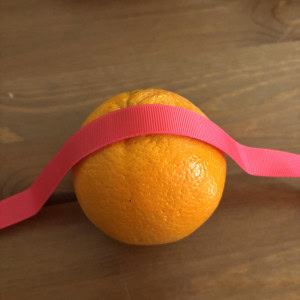
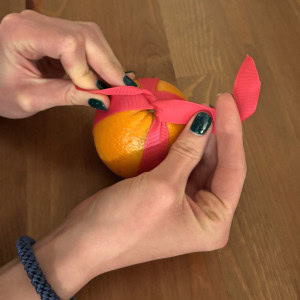
Take your orange and wrap your ribbon around it in a cross-shape. Putting on the ribbon can be tricky, so if you feel like it’s moving or slipping off, pull it a little tighter or use a pin to secure it at the base. Start with laying the ribbon across the top of your orange so the centre of the ribbon sits at the top of the orange.
Step 3

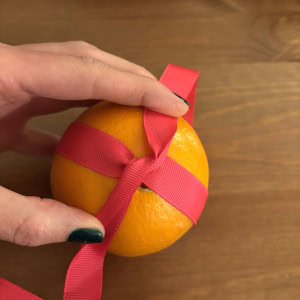
Pull the ribbon down the side of the orange and twist it together at the base.
Step 4

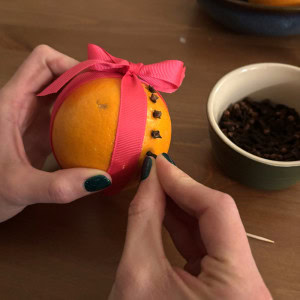
Then pull your ribbon up over the opposite sides of the orange and secure it at the top in a bow.
Step 5

Next, stud your whole cloves into your orange to create a pattern. You can creatively arrange the cloves in diamonds, stripes, circles, or other patterns.
Step 6

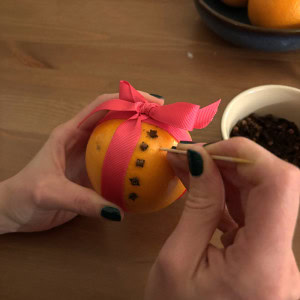
Use a toothpick to create premade holes for your cloves if you find it tricky to push them into the orange. Watch your fingers on the cloves, they can be a little spiky!
Step 7

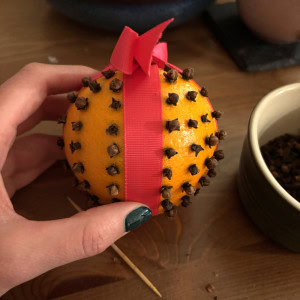
That’s it! You can display your pomander as a festive decoration and enjoy the Christmassy scent of the orange and cloves, or gift it to a friend or family member. Make sure to wash your hands afterward – some orange juice might escape when you’re studding your orange with the cloves so they might be a little sticky!