Dig Diaries 2026 – Bedrule Castle
This summer, members of the YAC have been joining excavations across the UK as part of our annual Dig It! competition. In August three lucky winners spent the day at Bedrule Castle in the Scottish Borders. Winners were hosted by the team at HARP Archaeology and investigated the site of a medieval castle that played a vital role in the Anglo-Scottish wars of the 16th century!
HARP have been kindly hosting YAC Dig It! competition winners for a number of years and this year the team returned to the site of Bedrule Castle to continue excavation at the castle site as part of Archaeology Scotland’s Towers of Rule project that has been running in the region for the past several years.
This blog post was written by one of the three competition winners, Atticus, 14, from Edinburgh YAC.
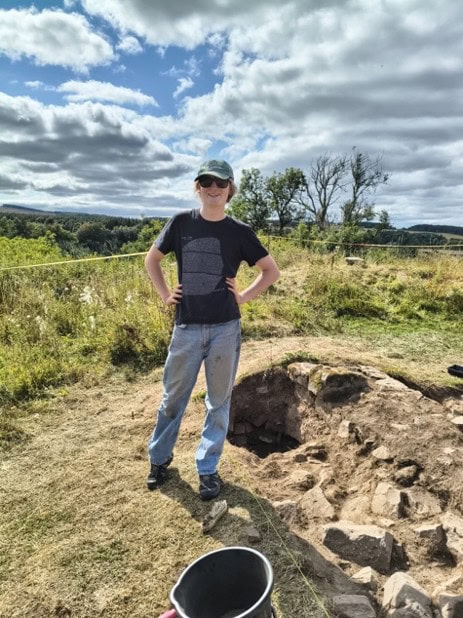
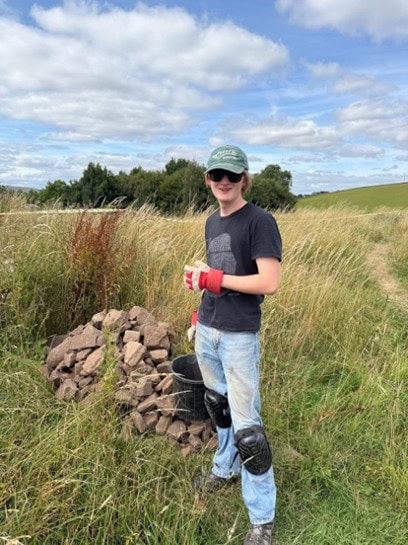
I couldn’t believe my luck when I won the Young Archaeologist Club (YAC) competition to a dig day at Bedrule in the Scottish Borders. Thank you so much YAC! I’ve been very keen to take part in a dig for years now as I have a deep interest in ancient history, material cultures and archaeology. I was sent a wonderful gift of a canvas bag that contained essential archaeological equipment; a brush, trowel, a pen, measure and notepad and a magnifying glass.
On arrival at the village hall, we were briefed on the fascinating site at Bedrule. We learned about the long history of the Turnbull clan who were renowned reivers (cattle thieves) in the Scottish Borders area. I learnt about the function of Peel towers in the area as protective mini keeps to defend against the reivers and information about Bedrule Castle. Little has been recorded about the site which made the dig all the more mysterious and exciting.
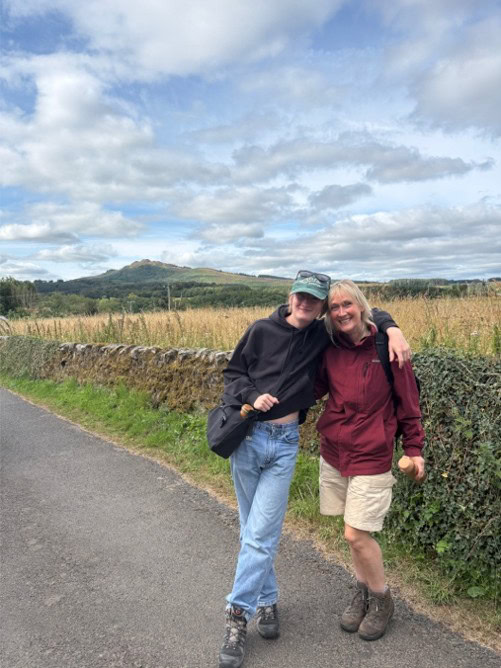
The dig site was not far away, on top of a hill with beautiful, expansive views of the surrounding countryside. It was a hot day and perfect for digging. The site was easy to navigate and made up of areas being cleared by volunteers and students and spoil heaps (a heap for earth, a heap for small stones, and a heap for large stones) several metres away.
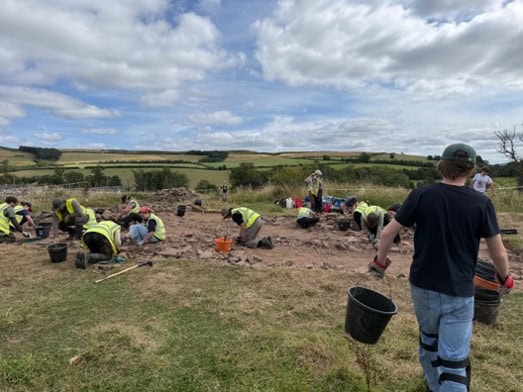
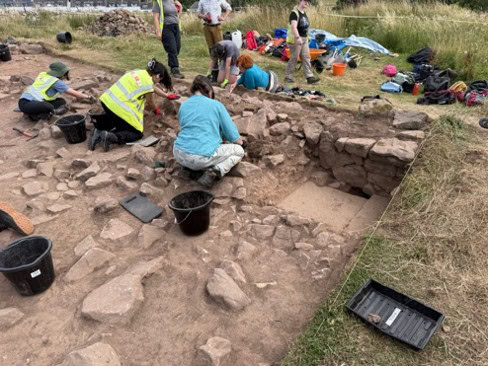
I was looked after by the extremely knowledgeable and friendly Dig It team who were able to answer my many questions. Michelle’s explanations helped bring the work to life; she told us that they believed that a wall of the site had collapsed and that the rubble on either side of the wall (tumble) needed to be separated from the wall itself.
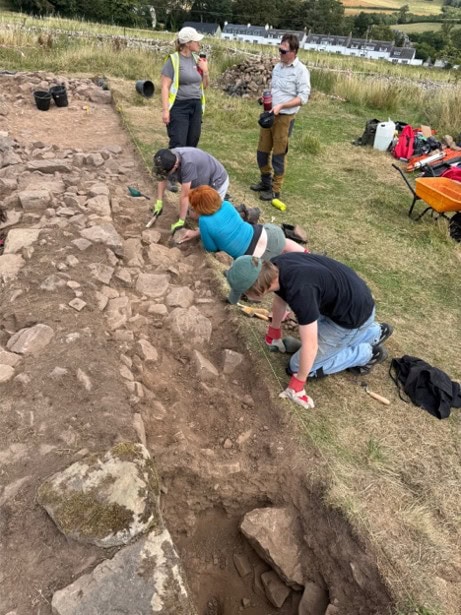
Michelle used an analogy of a demolished Lego build to explain the area we would be working on. She asked us to imagine a partial Lego wall left on the baseboard with Lego rubble on either side of the remaining wall. Her explanation really helped me picture the distinction between the wall and tumble and understand what I was doing. I learnt how to clear the tumble with a trowel down to the level laid out, collect the dirt in buckets and sort and collect the stones to be removed to take them to the spoil heap.
Clearing the dry earth from the rubble was methodical, focused and quite zen. I really enjoyed working outside and felt very concentrated on the task in hand. I found Michelle’s explanation of the different coloured layers of soil extremely helpful to understand where to clear and where to stop. After each layer was excavated a member of the Dig It team used LIDAR, an advanced method of topographic mapping, to record a 3D scan of the top layer of the site. Incredibly, the LIDAR was available on his iphone app!
I learnt how to hold a trowel correctly, pull it towards me and use the flat edge rather than the tip and the process of clearing including making the rubble “clean” with a brush before breaking for lunch. I also learnt how to sieve dirt to ensure that no finds were mistakenly taken to the spoil heap.
I’ve always wanted to take part in a dig and winning the competition gave me the opportunity to gain a first-hand insight into the world of archaeology. After the day at Bedrule I feel so excited about the variety of future careers ahead of me in archaeology and, thanks to Michelle, more aware of the different avenues I can take.
Thank you Atticus for this excellent summary of the day!
This year’s Dig It! bursary was made possible by the kind generoity of the Marsh Charitable Trust. These £80 bursaries were created to help cover the costs of travel, accomodation and/or subsistence for each winner. We are also grateful to Past Horizens for providing our Dig It! winners with havisacks full of archaeological tools to use on the day of their digs.