Bake a Medieval Simnel Cake

Simnel cake is a traditional yeast-leavened bread that is eaten during lent and at Easter (and is also associated with Mother’s Day). Originating in the medieval times, it was special because it was made out of the highest quality flour possible, simnel. The name may derive from the Roman ‘simila conspersa’, meaning ‘fine flour’.

Eating the cake signifies the end of Lent so it is rich with the butter, eggs and milk which were restricted during Lent. In later variations, marzipan or almond paste is baked into the middle and topped with eleven marzipan balls representing the disciples of Jesus (omitting Judas). References from the 17th Century show that Simnels were also sometimes boiled.

We have adapted a medieval recipe that contains alcohol, replacing it with honey and apple juice. The recipe is very flexible and can be adjusted to your tastes or what you have in the cupboards.

FLOUR – please use white flour but either Bread Flour or Plain Flour (if using Plain Flour add 1 teaspoon baking powder). Both work well, depending on what you might have.

SPICES – Any that you have or prefer would work, e.g cinnamon, allspice, mixed Spice. I would not recommend using all black pepper though!

DRIED FRUIT – Again, any combination you have or even just one variety. 

MILK – Any dairy/dairy-free milk.

APPLE JUICE – I used apple juice for sweetness but any other fruit juice or water could be used.

Adapted from this recipe. 

Janet Rothwell – Chiltern YAC

Adult supervision is not required for this activity.

Type of Activity : Cooking

How many people required (minimum) : 1

Safety Measures : Please ask an adult to help you use the oven

Ages : 8+

Time Required: 3+ hours

Step 1

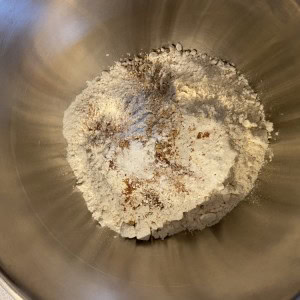
Mix the dry ingredients — flour, sugar, yeast, spices — in a large, sturdy bowl.
Step 2

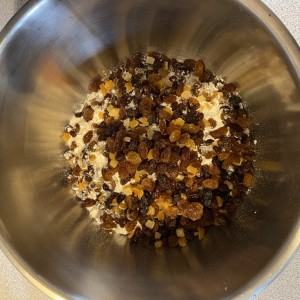
Add the raisins and currants.
Step 3

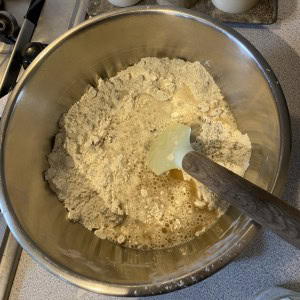
Add the milk to the dry mix and stir it in. Add the eggs, apple juice and honey. The mix should resemble a rough dough that you can shape into a ball. If it’s too wet to handle, add a little more flour by the tablespoonful. Alternatively, if it’s too dry, add water, milk, or apple juice by the tablespoonful to soften it.
Step 4

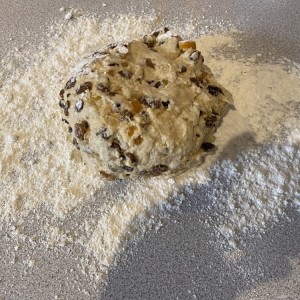
Knead the dough on a floured surface for five minutes until the dough is smooth. It should look glossy and consistent. Don’t worry if the raisins and currants keep falling out of the dough! Just fold them back in. Shape the dough into a ball.
Step 5

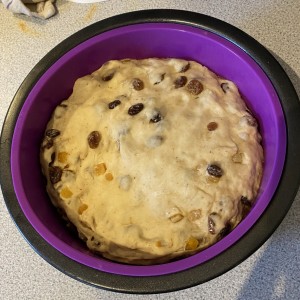
Place the dough into a bowl greased with butter, baking spray, or oil. Set in a warm place to rise for about an hour and a half. This dough doesn’t rise dramatically because of the huge amount of dried fruit mixed into it. The dough is ready to bake when it springs back when poked.
Step 6

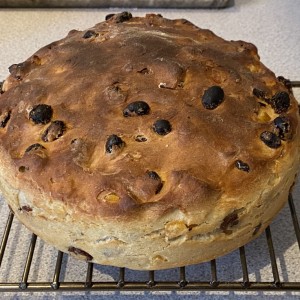
Bake for 25–35 minutes until the loaves are nicely browned on top and bottom. Test after 25 minutes and if not cooked leave for another 5 minutes then retest. Keep testing at 5-minute intervals until cooked. When you turn it over and tap the bottom, the bread should make a hollow sound.
Step 7

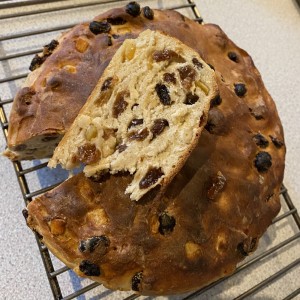
You can decorate your cake with marzipan if you wish or simply eat it straight out of the oven (once it's cooled down of course!).